
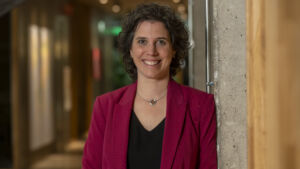
 Maaike Endedijk
Transformative learning for sustainable futures
At the research group Transformative Learning for Sustainable Futures, we investigate how individuals and groups engage with complex societal challenges, particularly those related to sustainability transitions. These challenges often involve uncertainty, ambiguity, and competing perspectives, requiring not only new knowledge but also shifts in how people interpret, evaluate, and act upon information. Our research focuses on how people, both individually and collectively, make sense of such current and future challenges, reconsider and integrate diverse perspectives, and co-create shared directions for potential solution pathways.
We approach these issues from both a learning and a collaboration perspective. From a learning perspective, we examine the processes through which individuals question existing assumptions, develop new frames of reference, and engage in perspective transformation. From a collaboration perspective, we study how interaction, dialogue, and social processes contribute to collective meaning-making and coordinated action. In doing so, we pay particular attention to how diversity in perspectives can both challenge and enrich learning and collaboration processes.
A central aim of our work is to better understand the temporal dynamics of transformative learning. Transformative processes typically unfold over time and across contexts, involving iterative cycles of reflection, interaction, and action. By gaining deeper insight into the mechanisms and conditions that support or hinder these processes, we seek to identify how transformative learning can be effectively fostered in educational, organizational, and societal settings.
Building on this knowledge, we develop and evaluate support measures and tools that facilitate learning and collaboration in times of change. These may include intervention strategies, learning designs, facilitation approaches, and digital tools that help individuals and groups navigate complexity, engage in constructive dialogue, and work towards shared, sustainable futures. In this way, our research not only contributes to theoretical advancement but also aims to support practical efforts to address pressing societal challenges.