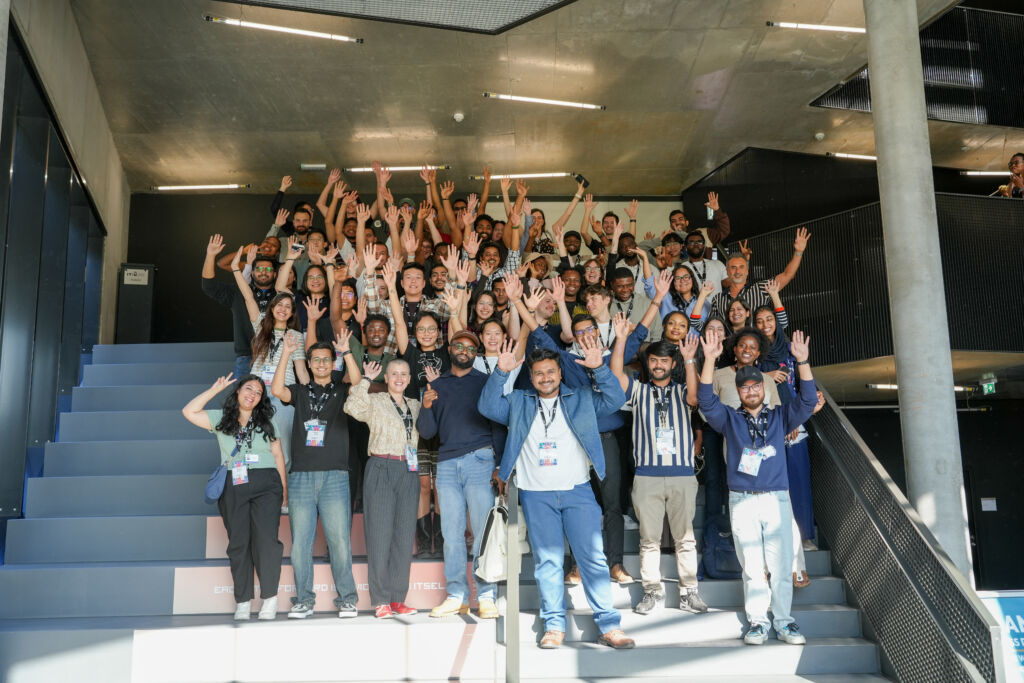


Welcome to IT:U: Where learning happens in LearnLabs, not lecture halls
At the start of the 2026/27 academic year, IT:U welcomed 101 new students to its Master’s and PhD programs. This brings the total number of students at the university for transformation in Linz, founded in 2023, to 178. From the outset, students combine knowledge from different disciplines and work together on real-world challenges, actively shaping transformation in science, business and society.
Learning together to shape the future
Transformation cannot be driven by a single discipline alone. That is why IT:U puts active, interdisciplinary learning at the heart of its educational model. Rather than attending traditional lectures, students work in small teams in the university’s LearnLabs, bringing together different perspectives and methods to develop solutions to real-world challenges. AI and digital technologies serve as tools to explore new approaches, always considering their economic and societal implications.
A representative survey conducted by IMAS on behalf of IT:U in June 2026 highlights the relevance of this educational mission: 61 per cent of people in Austria consider universities specializing in AI and digitalization to be highly important for the future labour market.
“The challenges of our time extend beyond individual disciplines. That is why we also design teaching and research in our LearnLabs across these boundaries. Students learn to explore new topics together with others, developing the ability to think knowledge further, weigh different perspectives and test approaches even under conditions of uncertainty. This approach prepares them to work on future questions that we cannot even anticipate today, and to actively shape technological and societal change.”
Stefanie Lindstaedt, IT:U Founding President
Interdisciplinary learning in practice
The first Master’s cohort of 2025/26 has already demonstrated how collaboration across disciplines works in practice. In the “Human in the Loop” course, students from different academic backgrounds developed a cycling simulator combining a physical prototype with a virtual environment. This enabled them to investigate how people experience cycling in controlled, realistic traffic scenarios.
Such experimental setups make it possible to study human responses without having to recreate situations directly in the real world. They provide a valuable foundation for future research into cycling behaviour, safer mobility systems and bicycle infrastructure.
Projects like this bring together hardware development, software engineering and research. Rather than acquiring knowledge in isolation, students apply their expertise directly to a shared challenge. Along the way, they learn to communicate across disciplines, consider different perspectives and develop solutions collaboratively.
International perspectives with local impact
Students from Austria and 49 other countries study and conduct research together at IT:U. They bring experiences from different educational, professional and cultural backgrounds, helping them question familiar assumptions and evaluate potential solutions from multiple perspectives. International collaboration thus becomes part of everyday university life, connecting global perspectives with concrete challenges in the region.
Highlighting the link between the university’s international outlook and its regional impact, Lindstaedt explains:
“We bring people with different experiences and skills to Austria and bring them together here. Students from Austria build international networks and learn to collaborate across disciplinary and cultural boundaries. International students can contribute their knowledge and develop connections with the region. Their studies open up opportunities to work and conduct research in Austria after graduation. In this way, we combine international openness with the goal of strengthening the region’s capacity for transformation.”