

Thirty-eight per cent of people set to live in mega cities by 2100, new study challenging current forecasts
More than a third of the world’s population will live in urban areas with over a million people by the end of the century, but most cities will grow slower as countries urbanize, according to a study using a novel data set.
Published in the journal ‘Proceedings of the National Academy of Sciences’, or PNAS, researchers from IT:U’s Transforming Economies Lab, ETH Zurich and the Complexity Science Hub used satellite data and nearly 200 years of historical records to analyze the evolution of urban systems across the world.
“Large cities are nothing new. Rome already had a million inhabitants in antiquity. What is new is the pace of growth”, says study co-author, IT:U Professor of Economic Transformation and Complexity and the Complexity Science Hub, “New York reached 10 million by 1925, Tokyo 20 million by 1965, and today more than 40 million people live in greater Jakarta”.
Thirty-eight percent growth is a stark increase compared to today, with World Bank data showing about 25 per cent of people currently live in such metropolitan cities.
But it is substantially less than current growth trends would suggest.
“Our model projects about 450 million fewer people living in million-plus cities by 2100 – a difference much larger than the current population of the United States,” says author Alexandra Musso, who is a Junior Fellow at the Complexity Science Hub and PhD Student at ETH Zurich.
Challenging the mega city myth
The research shows that in countries that are beginning to urbanize, large cities grow much faster than smaller ones.
People move to places where they can find jobs, good schools, and other opportunities.
This can currently be seen in many areas of Asia and Africa.
But over time, the attraction of a country’s largest city seems to weaken.
“As a country’s urban system matures, that advantage fades and cities of all sizes grow at similar rates. The concentration of populations in the largest cities therefore need not continue indefinitely: in countries with mature urban systems, it has already begun to level off,” says Professor Neffke.
This, Professor Neffke says, can be seen in heavily urbanized areas of the United States and Europe, where smaller and larger cities have grown at similar rates.
This stabilization suggests a more balanced future; so, fear not; we are most likely not destined to “all end up in a 100 million population city”.
How did they gather the data?
Comparing cities across different continents, from the old cities of Europe to the newer cities in North America and the more recent megacities in Asia and Africa, is difficult because each country defines its cities differently.
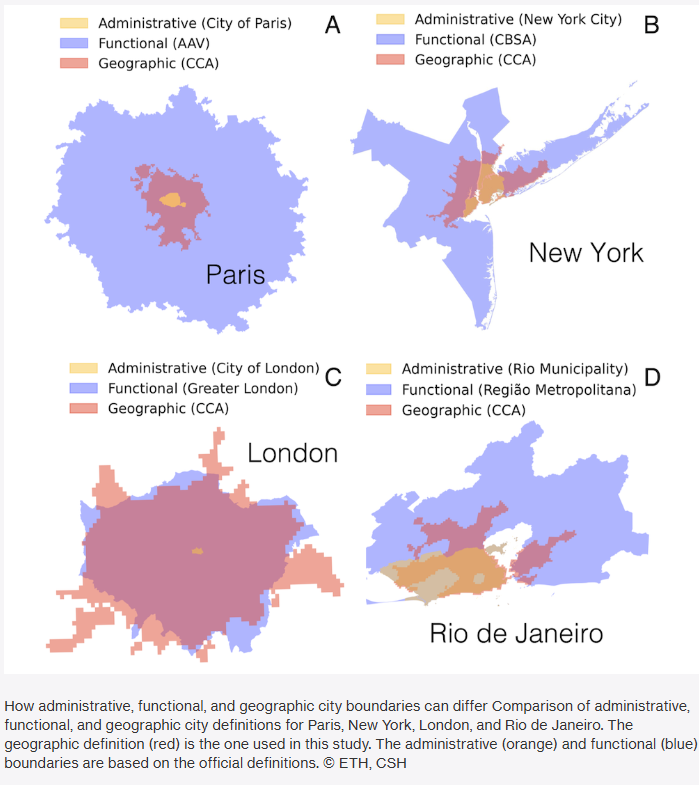
The researchers constructed a new dataset that allows for a direct comparison of city populations across different time periods and countries.
They used spatial algorithms on U.S. census data (1850-1940) and global satellite imagery from the 1970s to today that allowed defining city boundaries according to a set of standard criteria.
This “harmonized way of defining city size is crucial to compare not just individual cities but entire urban systems both across space and in time”, says Professor Neffke.
Benefits and risks for a carbon-neutral future
When you double a city’s size, you do not need to double the number of kilometers of road, sewage, and communication infrastructure.
However, there is a “density debt” to pay. The same proximity that fuels innovation can also lead to more disease and heat problems.
A lack of green space could turn the bustling streets of large and dense cities into heat traps as the climate warms.
The projections provided by this study will help experts prepare for the challenges of urban life in the coming decades.
“Knowing that urban growth follows a predictable life cycle is enormously important for decision-makers,” Professor Neffke says, “it can help guide infrastructure planning, climate adaptation strategies, and forecasts of future economic growth”.