

The science behind your doctor’s advice can take years. A new AI tool aims to speed it up
Imagine sitting in a doctor’s surgery asking for the best treatment for your ailment, be it a vaccination, the summer flu or some other illness, and your trusted GP gives you advice.
That advice is usually based on the best available evidence.
But behind the advice is a process that can take scientists years to put together.
A new AI tool developed by an international team led by IT:U scientists could help speed up how researchers produce such medical evidence, getting trustworthy answers into your doctor’s hands faster.
“Right now, producing solid medical evidence can take years. We are working to speed that up.”
Yufang Hou, Professor of Natural Language Processing at IT:U.
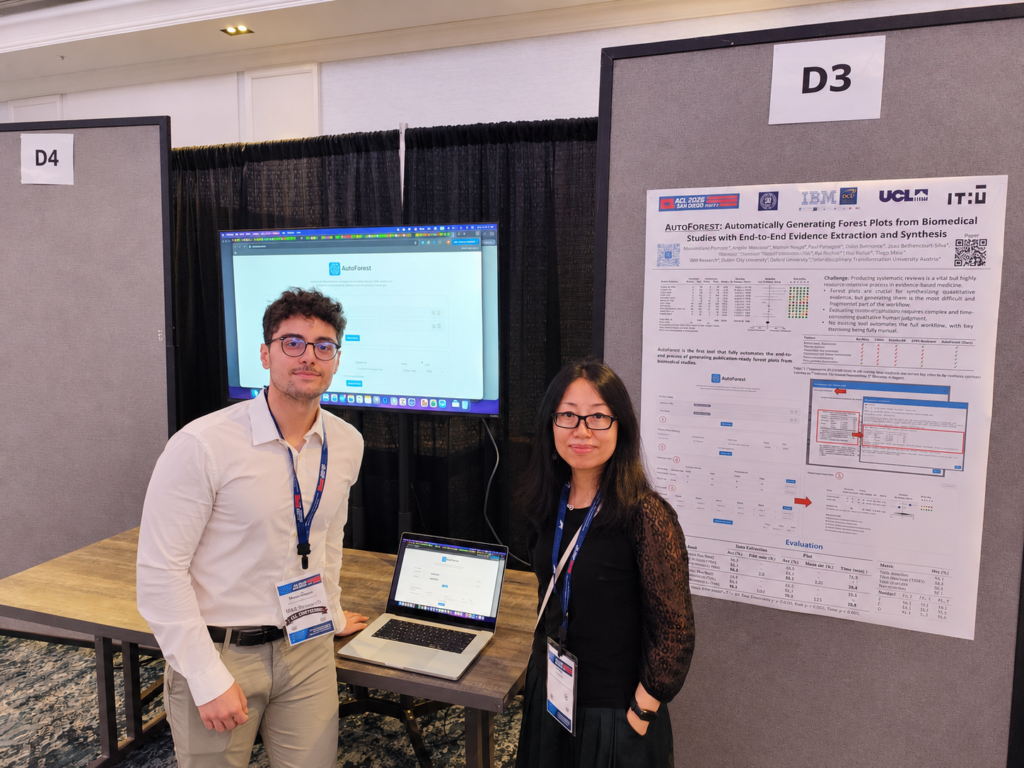
The tool, called AutoForest, has been developed in collaboration with Dublin City University, University College London, IBM Research, and the University of Oxford.
The IT:U team is presenting it in San Diego at ACL 2026 this month, the 64th Annual Meeting of the Association for Computational Linguistics, one of the leading conferences in AI and natural language processing.
The slow path from research to recommendations
Before your doctor can recommend one treatment over another, scientists need to analyze the results of hundreds of different studies and combine them into a clear recommendation.
This process is known as a systematic review.
It is a time-consuming process as “you might start with thousands of studies and end up with just a handful that actually answer your question”, Professor Hou says, “it can take one to two years to complete just one review, and it can cost nearly 90,000 euros.”
AI tool to speed up the process.
The new tool is designed to tackle that problem by working alongside the scientists who carry out these reviews, rather than replacing them.
To use it, they upload the relevant studies, and the device works out what is being compared.
It “pulls the key numbers out of each paper, helps them assess each study’s risk of bias, runs the statistics, and draws the result as a forest plot, the standard chart that sums up medical evidence at a glance”, the professor says.
Early testing suggests the tool could significantly speed up part of the process, Professor Hou says, with tasks that once took hours of work now completed in about half the time.
And that matters because as Professor Hou emphasizes “there are far more questions than scientists can currently answer with systematic reviews. We are trying to close that gap”.

Most importantly, she says, the quality of the data would remain the same as experts would still oversee the process.
It is the result of several years of work by Hou’s team, including a first public benchmark for the task, and new ways to make AI reason reliably over the numbers in clinical studies.
Who would use it?
Delays in understanding treatments can have real-world consequences, with patients waiting for potentially life-saving treatments while experts examine scientific papers.
Tools like AutoForest aim to address that problem at its source by helping experts produce high-quality evidence faster.
The system is still in its pilot stage and rolling it out to the wider public will take some time.
Despite its promise, the system is not something the public could use directly, as interpreting medical evidence still requires specialist knowledge and human oversight.
“It is not designed to replace experts or give medical advice,” Professor Hou says, “it is there to support the scientists”.
But while it is not intended for the public to use, scientists could develop similar systems for them in future, so people would have a better source than ChatGPT.
For now, the impact is more indirect but no less important, because if scientists can work faster, your doctor might offer you the latest advice sooner.