

Rethinking proof of learning in higher education in the age of AI
A university degree is a claim about what its holder can do. Until now, the work students handed in was how universities assessed that claim. In 2026, universities are finding out that a completed assignment reveals much less information about the skills of the student who submitted it. This owes to the generative AI tools that rapidly went from novelty to routine in a few years. In its ninth Future Report, IT:U looks at what a university can still point to as proof of learning.
Assessment is losing its grip
A study published in Science in May 2026 surveyed 95,513 students at twenty major public research universities in the United States. Around two-thirds had used generative AI tools during the 2023/24 academic year, and 37 percent used them regularly. The researchers estimated that 9 percent had used them to cheat.
The tools are not the problem. Students who will graduate into workplaces where these systems are standard should be fluent in them, and a degree that left them unpractised would be weak. What the figures put in question is the form of assessment.
Europe already wrote down what a Master’s graduate should be able to do
In 2005, meeting in Bergen, European education ministers adopted a written description of the capabilities each degree level represents. Known as the Dublin descriptors, it says a Master’s graduate should be able to:
- apply knowledge in new or unfamiliar environments, including those spanning more than one discipline
- make judgments on incomplete or limited information, with reflection on the social and ethical responsibilities involved
- communicate conclusions and the reasoning behind them to specialist and non-specialist audiences
- keep learning independently, without being told what to do next
The Dublin descriptors tell the educators and employers what they can look for in a graduate. How to create the circumstances in which a student can learn these skills and show them is a question of learning method.
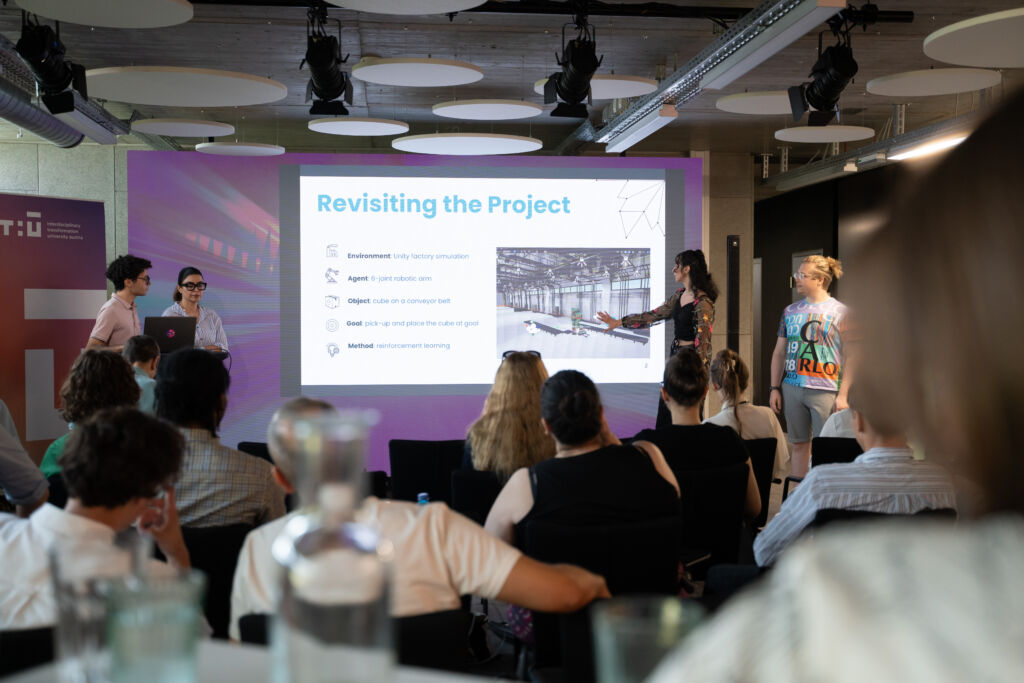
At IT:U, project-based learning is the method by which the students are being prepared for the future by not only possessing knowledge but by learning how to apply and communicate it. What that looks like in practice became more salient in June, when IT:U’s first master’s cohort presented their pre-specialization projects.
What IT:U’s first cohort showed in June
The pre-specialization projects come at the close of the second semester. Students have chosen one of four fields by then, and this is the first time they work on a problem inside it. A team of four or five takes on a problem set by a research group and works on it in the LearnLabs, supported by Professors, Lab Experts, and Learning Coaches.
Students enter the pre-specialization module from different academic backgrounds, bringing different perspectives and methods to the same problem. The project bridges the shared foundations of the first year and the deeper specialization work that follows, giving students a first opportunity to apply what they have learned in a more focused field.
The problems are unfamiliar to the students who take them on, and the information available is incomplete. The approach is theirs to work out. The audience at the presentation is drawn from across the university, and most of it works in other fields.
A selection of the projects are described below.
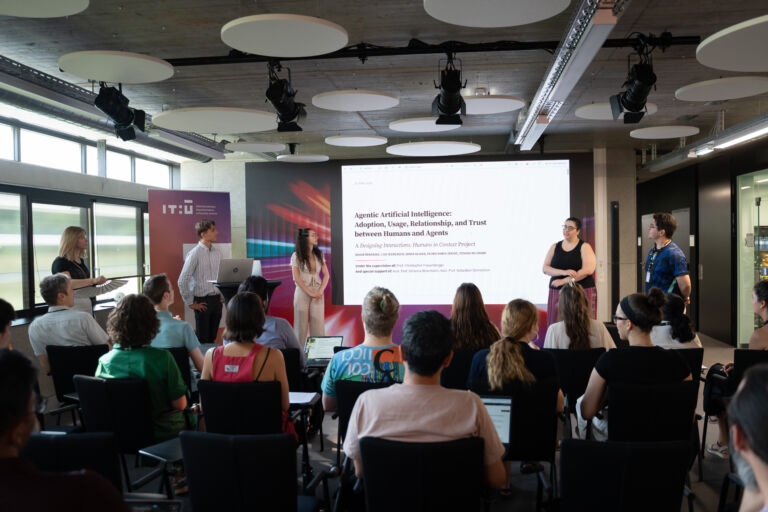
Handing work over to an AI agent. From their interviews, one team concluded that trust in the tool does not rest on its performance alone. People grant their trust conditionally, on terms they set themselves. Responsibility stays firmly with the person even as the systems become more autonomous, and what changes is the work itself, from doing it to supervising it. They published an open playbook, and set out the weaknesses of their own study, including a sample weighted toward male professionals.
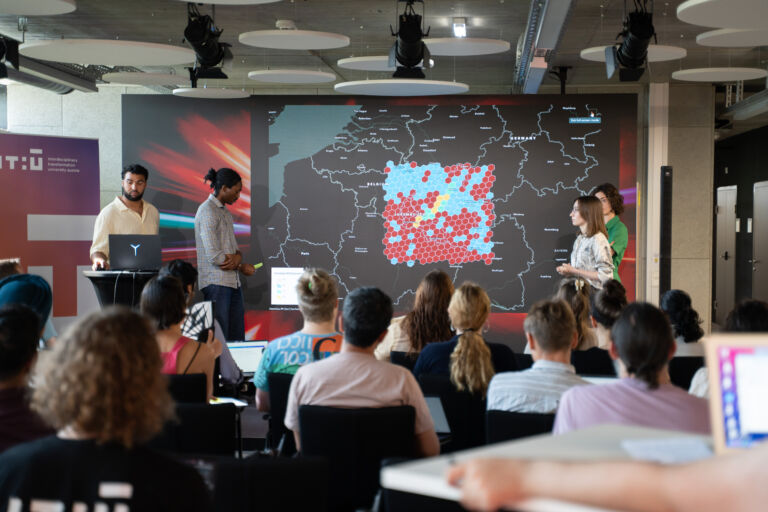
Detecting disasters from social media posts. A published method for spotting disasters from social media posts, developed by the team’s supervisors, was tested on hazards and regions it was not built for. Using a classifier trained on 179,000 labelled posts, they compared their results against the European Union’s official satellite damage maps for floods in Germany, wildfires in Spain, an earthquake in Japan and a hurricane in the Bahamas.
Predicting survival from patient records. A team worked with 17,204 artificial patient records and predicted that heart failure and kidney disease patients would be likelier than asthma patients to die within a year of diagnosis. The overall death rates looked dramatic. Then they tested the prediction they had actually made, and found that the gap came from deaths accumulated across the whole record rather than within a year. They also noticed that their asthma patients were children, median age five, against fifty-five and fifty-nine for the other two groups.
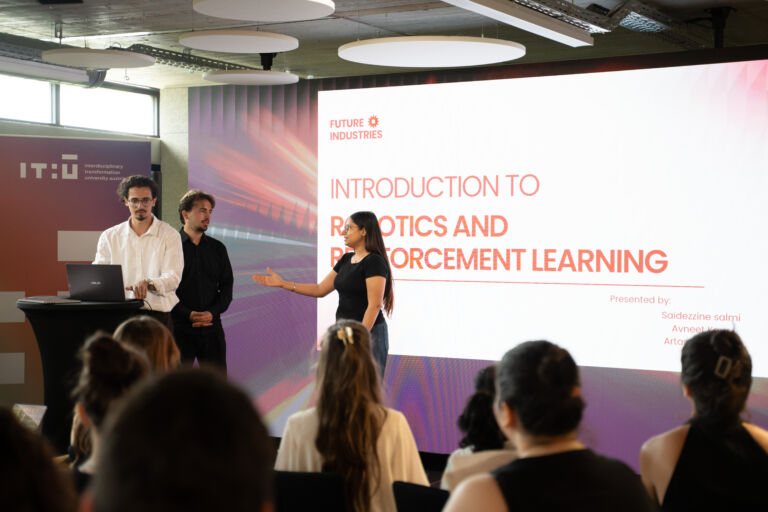
Teaching a six-jointed robotic arm to pick up an object and set it down. The method was reinforcement learning. In each case the difficulty turned out to be the design of the reward, arrived at by repeated revision. One team reported that how rewards are distributed matters more than how large they are, and that training for longer can make performance worse. Another reported that larger rewards and more episodes were what improved results.
Beyond the known answer
Every one of these projects used computational tools, and several used AI directly. The problems the teams were tasked with were genuinely open-ended: the people who set the briefs did not already know what the solutions would be.
A project whose own authors report that its result collapsed and what one can learn from it cannot simply be handed in as a file. This all took place in the second semester, roughly a year before these students begin a thesis, and none of it was designed as an exercise with a known answer.
Designing education for the real world
Europe’s rules for assuring the quality of university education are now being rewritten, for adoption in 2027. What a Master’s graduate should be able to do is not what is changing. What remains open is how institutions demonstrate that they can do it. That is a question of program design, and it is precisely in that space that IT:U has chosen to innovate: by designing programs in which students have to use computational and AI tools to confront open-ended problems.
Not because these are fashionable additions to education, but because they are closer to the conditions in which graduates will actually have to work. The point is not to teach students how to produce an answer. It is to prepare them to find out what holds up when the answer is not known in advance.
Want to learn more or collaborate with IT:U?
Discover the IT:U Future Report and connect with our Outreach & Startups team.