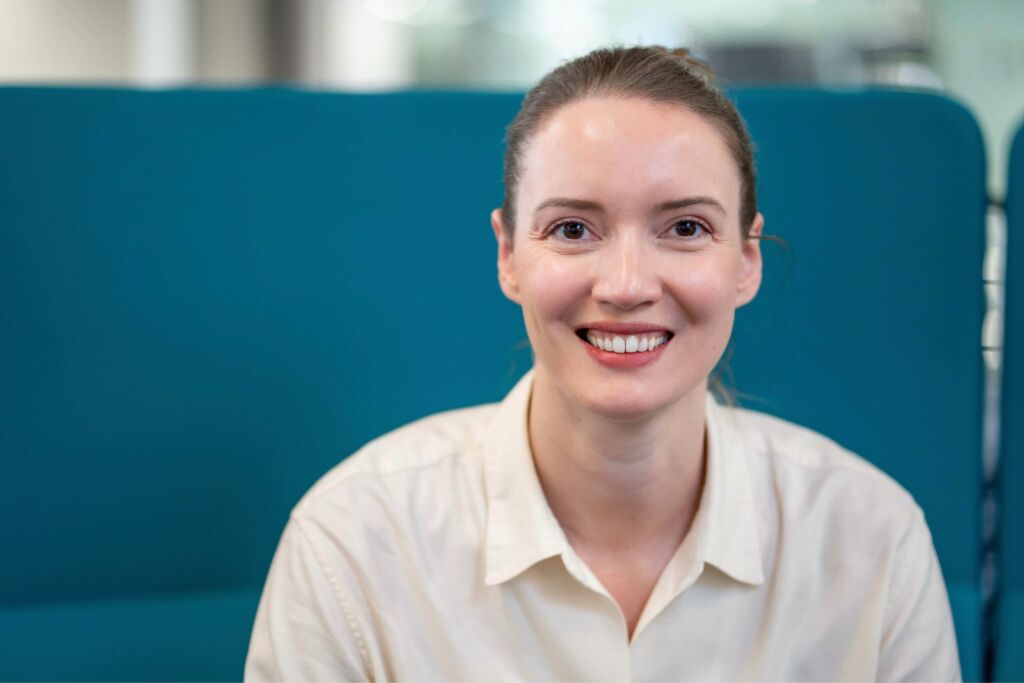


Meet Dinara Talypova – Associate Researcher & PhD Candidate in Computational X
Meet Dinara Talypova, an associate researcher & PhD candidate in the Computational X program at IT:U and a member of the Intelligent User Interfaces research group.
ABOUT YOU
1) Where are you from?
I came from Moscow, Russia, in 2018 to start my Master’s in Cognitive Science in Vienna.
2) One fun fact/secret talent about you?
Despite working with technology, or more precisely, exploring how people interact with technology, I really enjoy interacting with analog things: musical instruments, painting, sewing. I must admit, I’m not good at most of them, but “a samurai has no goal, only the path.” Several years ago, I read The Craftsman by Richard Sennett about the importance of doing craft for its own sake, and it unlocked a whole bunch of hobbies that now exist happily out of the public eye 😊
3) Where can we find you (in Linz) when you’re not working?
I actually live in Vienna, so it’s better to look for me on campus in Linz. But I really love Upper Austria for its beautiful lakes and hiking paths. I can highly recommend Ebensee. It offers stunning views and great hiking opportunities.
ABOUT YOUR RESEARCH
4) What did you study/work before IT:U?
I studied Communications in Moscow and later completed my Master’s in Cognitive Science at the University of Vienna. My Master’s program was my first real experience with interdisciplinary studies. Within one cohort, it brought together philosophers, psychologists, education specialists, biologists and neuroscientists, as well as programmers and computer scientists. The cohort consisted of only 25 people, and I was among the five who did not have a scientific background in cognitive science. We worked mostly in groups, and the program strongly emphasized collaboration between people from different backgrounds. Each semester, we also completed a new internship in labs from various disciplines, working on research projects. Sounds familiar, don’t you think?
5) What is your current research focus?
I study how people can stay focused, intentional, and in control in environments that constantly compete for our attention. More specifically, my goal is to design AI systems that support human productivity and focus without undermining our autonomy. My three research questions are:
- How people work and switch tasks within and across technologies, and how fragmented attention shapes modern workflows
- How users perceive and accept different forms of AI support for focus, productivity, and attention management
- How to balance AI assistance and human autonomy, ensuring that productivity tools empower users rather than take over decision-making.
6) Which project/publication are you most proud of?
This is a conceptual work that explores human autonomy in HCI through the lens of political philosophy, and how this perspective can help us understand the acceptance of AI assistance for productivity and focus. When it comes to AI assistants for attention and productivity, we have a rather paradoxical relationship with smart machines: we need to give up some of our freedom so they can “protect” us from disturbances, yet we then risk feeling no longer at the wheel of our own lives.
This may sound like a purely modern problem, with LLMs and recent AI methods, but in fact, this paradox has long been discussed in the relationship between individuals and political systems. Why not borrow some wisdom from philosophers of previous centuries to cope with today’s challenges? I’m very happy that I finally put these thoughts into writing, as they had been on my mind for quite a while. The manuscript on this topic has recently been accepted to one of the most impactful conferences in our field, the Conference on Human Factors in Computing Systems (CHI 2026), and I’m looking forward to sharing it with the community.
7) Imagine your research reaches its full potential—what kind of impact would it have in the future?
I believe that in Computer Science, researchers who study people are just as important as those who engineer machines. For a long time, we’ve mostly let engineers play on their own field, and the societal consequences of new technologies haven’t always kept up with their technical achievements. One could argue that the downsides sometimes outweigh the benefits: rising polarization, information bubbles, scamming and overtrust in systems, as well as deskilling effects. I see my impact in contributing to the part of the HCI community that cares about how technology lands in society, not just how gloriously it performs.
PHD LIFE AT IT:U
8) One unique thing you find about working here at IT:U?
I love how fast it’s growing and how it creates new rules and processes that everyone can contribute to. What really stands out to me is how passionate and young in attitude people are here. I haven’t seen such a high concentration of dynamic and open-minded people at other universities, and believe me, I’ve studied at a few.
9) What were the two biggest reasons for applying to IT:U?
Prof. Philipp Wintersberger, my supervisor, and the promise that this university lets creativity roam free.
10) What is one thing you love and appreciate about working at IT:U?
That it listens to its students and employees and doesn’t blindly follow a “one-size-fits-all” approach.
11) What advice would you give to someone thinking about applying to IT:U? (even from non-technical background)
As someone who came from a non-technical background myself and often felt like a black sheep in the Computer Science community, I can reassure you: the world needs more interdisciplinary specialists, and IT:U can help you embrace that, with pride.
PhD in Computational X – Closing Soon
Dinara’s story is just one example of how IT:U researchers are tackling real world challenges through interdisciplinary science and technology. The PhD in Computational X is now open across research groups including Computational Medicine and Health Data Science, Human Rights and Technology, Secure and Resilient Infrastructures, Energy Transition and Climate Futures, Acoustics, Analysis, and AI (3AI), Smart Sensing and Systems (S³ Lab), and Regulation and Governance of Information Technology.
Application deadline: 31.01.2026