


How making fermented foods and drinks could help make AI more interactive and inclusive
Since Iohanna Nicenboim lived in South America, she is concerned about the effect rare earth minerals mining has on local communities.
The removal of lithium needed for batteries and other technologies, including Artificial Intelligence, has a profound effect on people’s lives and the area’s ecosystems.
This extraction of what is locally known as ‘white gold’ on indigenous land inspired the IT:U Assistant Professor of More-than-Human Design and Regenerative AI, Iohanna Nicenboim, at IT:U to look at the relationship between the environment and AI.
“I wish the interactions with AI would bring the challenges to the surface. Right now, the commercial design of AI products is about hiding all that, so my big question is how we can bring it to the surface.”
Assistant Professor of More-than-Human Design and Regenerative AI, Iohanna Nicenboim.
Bridging Biology and AI
The fascination has been with her for some time – and in her role at IT:U she looks at what we can learn from other living things, including microbes, plants, and animals, when designing AI applications, such as chatbots, like ChatGPT.
Assistant Professor Nicenboim will take part in a panel this month at the Chi 2026 conference, where she will explore the relationship between biology and AI, which she says aims to “bridge these two fields that are currently very separate”.
But she cautions that while we will never fully understand AI, the way we can understand how a coffee machine works, for example, current design processes often fall short.
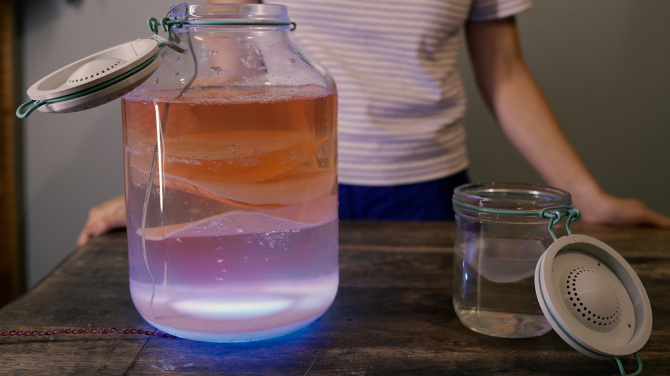 © Iohanna Nicenboim
 Making fermented foods can give insight into how to better design AI applications.
Growing fermented foods as a metaphor in AI design
Inspired by fermented foods and drinks, such as kombucha, beer or sourdough bread that need microbes to flourish, she designs chatbots and digital assistants.
Through that process, she reflects on how living with artificial intelligence is somewhat similar to living with simple organisms, as both cannot be fully understood.
At the heart of the fermentation process is reciprocity and care.
“People often get a starter from someone else under this relationship of trust. They also have a reciprocal relationship, where they must feed it and have a relationship of care. It is inspiring, because it means we don’t have to explain AI to people, we need to facilitate understanding, and we need to look at how people already do that when they interact with ChatGPT in their own ways.”
Failures and misunderstandings are invaluable learning tools that can be used creatively when designing new AI tools, according to the researcher.
She hopes it will make future AI design processes more holistic and include not only the ‘perspective’ of us humans but also of other living things.
Learn more/conference details:
The ‘CHI conference on Human Factors in Computing Systems’ is an international conference on Human-Computer Interaction, taking place in Barcelona from 13 to 17 April.
It features worldwide experts in the field, including from IT:U.