


Austria ranks fifth in Europe, but dependence on foreign tech remains widespread in EU
Only three per cent of organizations analyzed in a new study rely exclusively on European technology providers, highlighting the continent’s dependence on the U.S.
Researchers including from IT:U, TU Wien and FH Technikum Wien analyzed almost 2000 government institutions, universities, banks and media organizations across 27 EU countries and included the data in an interactive map, where users can look up what technologies their governments, banks, universities and media organisations are using.
“There is a substantial gap between Europe’s ambitions for digital sovereignty and what we actually see in the measurement data”, says co-author Dr Florian Holzbauer from IT:U´Secure and Resilient Infrastructure Department. This follows a study Dr Holzbauer and Professor of Security at IT:U, Johanna Ullrich, did earlier on local government dependencies.
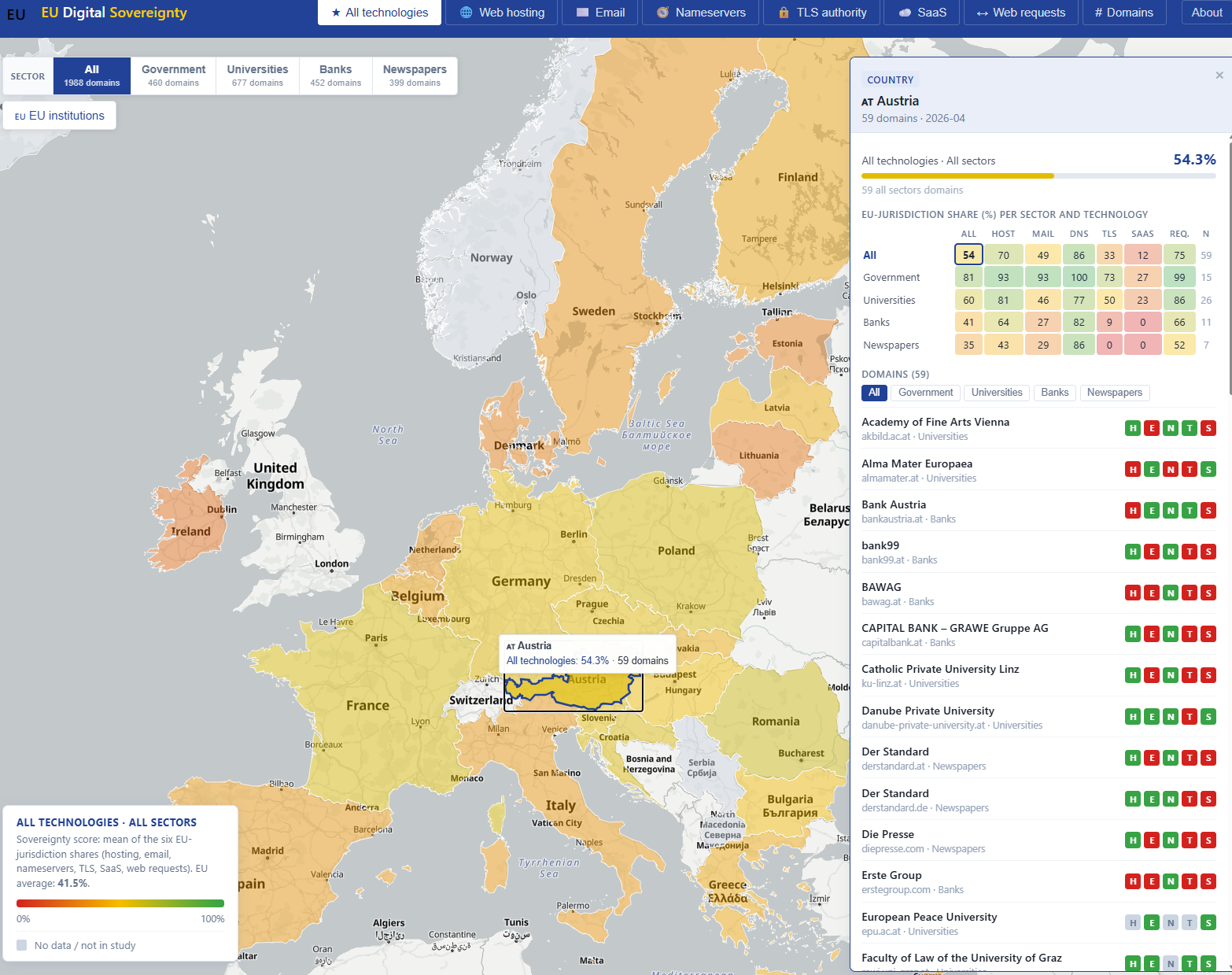
Digital sovereignty in Europe (@sovereignty.internetwarte.eu)
Romania, France and Poland ranked highest in the digital sovereignty score, seen in the new map.
Austria ranks fifth overall across the EU, but Dr Holzbauer says there are “significant differences between sectors. Government services score very highly, while banks and newspapers perform less strongly than in some other European countries”.
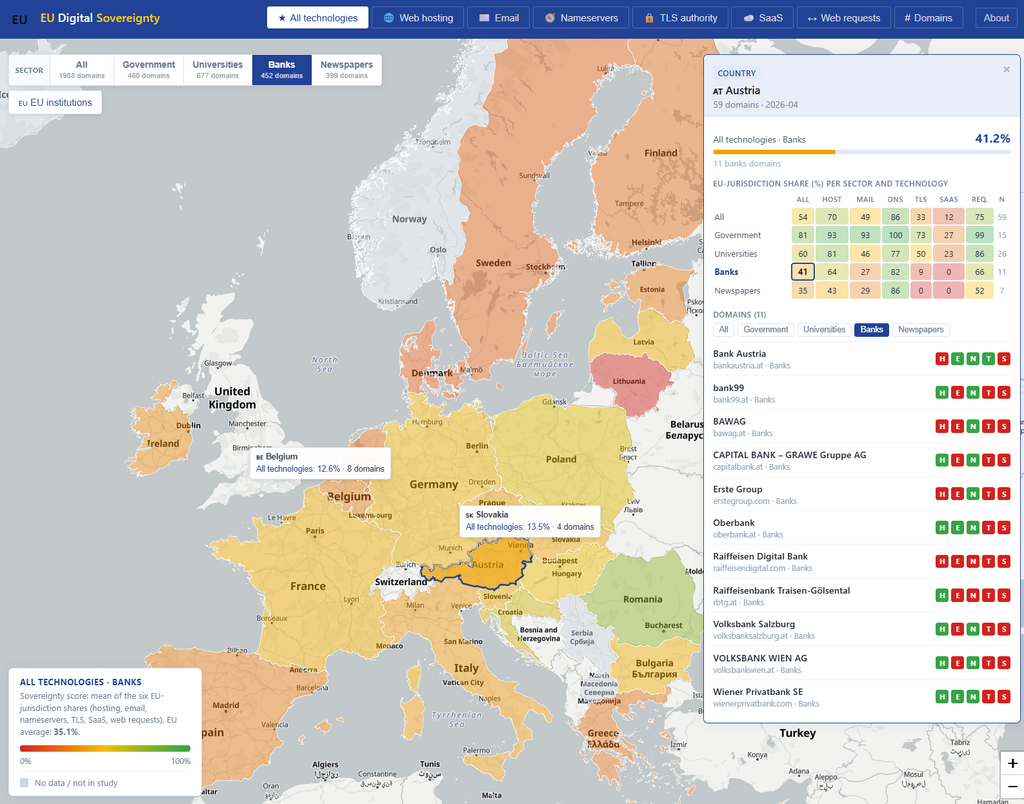
Digital Sovereignty: Banks (@sovereignty.internetwarte.eu)
Some countries associated with strong digitization, particularly in Northern Europe, ranked lower because they rely more heavily on U.S. cloud providers.
Microsoft has stronger share than thought
By using more advanced research methods, they discovered that Microsoft’s presence was much larger than expected.
“Using verification tokens, we found that Microsoft’s share rises from 35 percent to almost 60 percent of the measured domains. Google is also close to 60 per cent, while Amazon Web Services appears in around 20 percent of organizations,” he says, which shows that “dependencies can run much deeper than what is visible from the outside”.
Dr Holzbauer says the concern is not the technology itself but Europe’s dependence on foreign providers and the control they have over critical digital infrastructure.
This is of particular concern in the current geopolitical climate.
A heavy reliance on a small number of tech organizations raises the stakes, as a major outage could affect hundreds of organizations at the same time.
The way forward
But would Europe have the necessary infrastructure and experts to become fully self-reliant if necessary?
Dr Holzbauer believes it could be achieved with the right political and industry will.
“Open source has huge momentum, and with this momentum we could resolve a lot of these dependencies within the coming years.”
He advocates for a phased approach, similar to that taken in Switzerland, where organizations introduce local technologies alongside existing systems and gradually build the expertise needed to reduce their reliance on others.