

3rd International Workshop on Machine Learning and Quantum Computing Applications in Medicine and Physics (WMLQ 2026)
About The Workshop
The 3rd International Workshop on Machine Learning and Quantum Computing Applications in Medicine and Physics (WMLQ 2026) brings together research at the intersection of physics, artificial intelligence, quantum computing, and medicine.
The workshop is organised by the National Centre for Nuclear Research Poland in collaboration with several academic partners, including IT:U, the University of Vienna, Jagiellonia University, CREATIS Laboratory, and IFJ PAN.
WMLQ 2026 focuses on the exchange of methods and perspectives across disciplines. It provides a setting for researchers from physics, computer science, and medical fields to explore how shared approaches can be applied in different domains.
Host: National Centre for Nuclear Research Poland in cooperation with scientists from the University of Vienna, Jagiellonian University, CREATIS Laboratory, IFJ PAN and IT:U Austria
IT:U Involvement
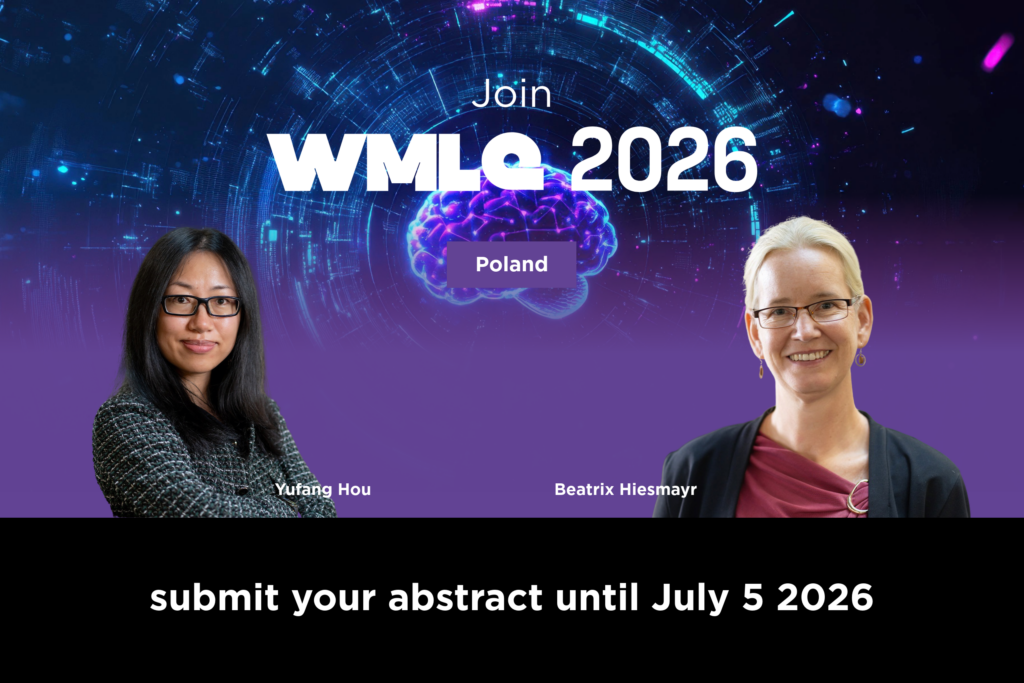
- Beatrix Hiesmayr, co-organiser & speaker of the workshop and professor at IT:U in quantum physics, entanglement detection, and medical applications of quantum phenomena
- Yufang Hou, invited speaker and professor at IT:U, specialising in NLP, large language model governance, and computational argumentation
Call for Abstracts
Researchers are invited to submit contributions.
Submission deadline: 20 July 2026
Further information on submission and registration is available here:
https://events.ncbj.gov.pl/e/wmlq2026
More Information
The workshop addresses current developments in applying machine learning and quantum computing to both fundamental research and practical use cases, including topics such as high-energy physics, astrophysics, medical imaging, and radiotherapy.
Topics
The programme includes, among others:
- Machine learning in medical applications
- Machine learning in high-energy physics and astrophysics
- Quantum machine learning
- Quantum simulations
- Quantum and quantum-inspired algorithms
- Generative models (e.g. GANs, diffusion models) for simulation in physics and medicine
- High-performance computing (HPC), including GPU and FPGA platforms
- Methods in medical imaging
Background
There’s one more thing: A part of the last sentence is missing. Under “Background”, it should be “Previous editions of the workshop (WMLQ 2022 and WMLQ 2024) served as venues for interdisciplinary exchange and collaboration, particularly in areas where similar computational and analytical methods are used across different research domains.” – also, there’s a line break after the word collaboration.