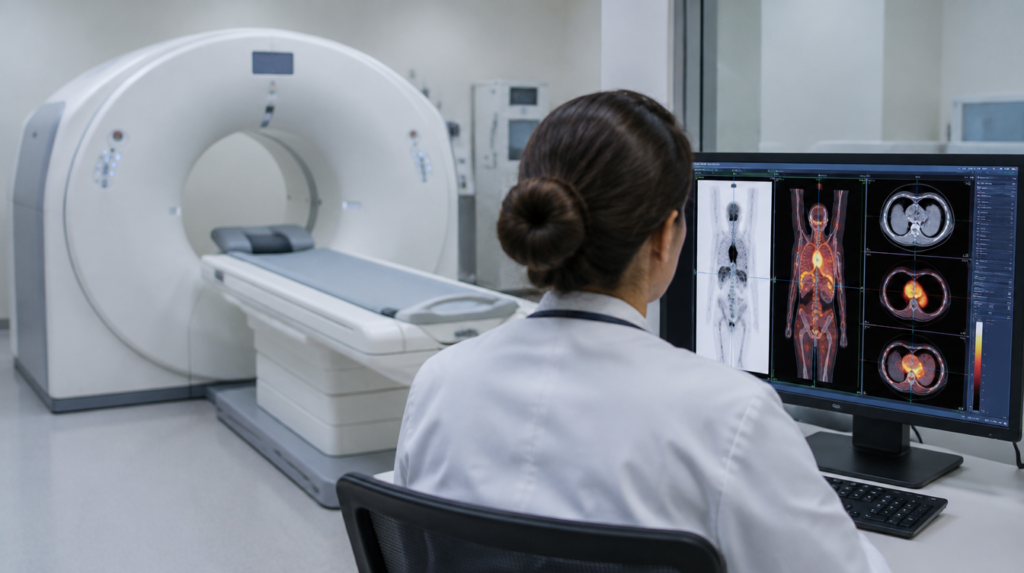


Looking with two eyes instead of one: A new way to look into human bodies
Physicists, including from IT:U, have found a new way to explore information hidden in PET scans, an advance that could one day lead to clearer cancer screenings.
PET, or Positron-Emission-Tomography scans, use a radioactive tracer to check for signs of cancer, heart disease, and brain disorders.
But scientists believe these scans may contain more information than previously thought.
“You can think of it as looking at a picture with one eye versus looking at it with two eyes,” says Beatrix Hiesmayr, Professor of Quantum Information and Technology at IT:U. “When you can use more of the available information, you may be able to see additional details.”
The research focuses on positronium, which forms naturally during these scans when a positron particle meets an electron particle inside the body.
While the technology is already highly effective, most systems concentrate on the simplest signals produced during this process.
“Current PET technology works very well, but it uses only the easiest part of the information available,” says Professor Hiesmayr, ”there is much more information hidden in these signals, and first we need to understand it”.
To do that, the team has expanded a widely used computer simulation platform, so researchers can study processes that are usually left out.
By testing different scenarios, researchers can find out how these overlooked signals affect the images produced by scans.
The work is still at an early stage, and patients will not see immediate changes in hospitals.
But additional information could eventually help produce sharper images and make subtle changes in the body easier to detect.
“The better the pictures are, the earlier you can see that something is starting to change,” Professor Hiesmayr says.
The new approach has been incorporated into the open-source GATE simulation platform, allowing researchers across the world to explore it.
For Professor Hiesmayr, the excitement lies in uncovering information that may already be present in scans but remains out of reach.
“What motivates us is the possibility that there is more information there than we can use today,” she says, “the more we understand these processes, the more opportunities we have to improve imaging in the future”.