

Who get’s to build tomorrow’s tech? Why diversity matters.
As technology increasingly shapes everyday life, two fundamental questions become more important: For whom is it built, and who gets to build it? For decades, technology has been developed within environments where men have significantly outnumbered women. While this imbalance is often discussed as an equality issue, its implications reach much further. Diverse teams don’t simply create more inclusive workplaces, they build better technologies.
Inclusion is built into the foundation
At IT:U, Austria’s youngest public technical university focusing on transformation, this understanding has shaped the institution from the very beginning. Rather than treating diversity as a separate initiative, the university sees different perspectives as a prerequisite for excellence in research, teaching, and innovation.
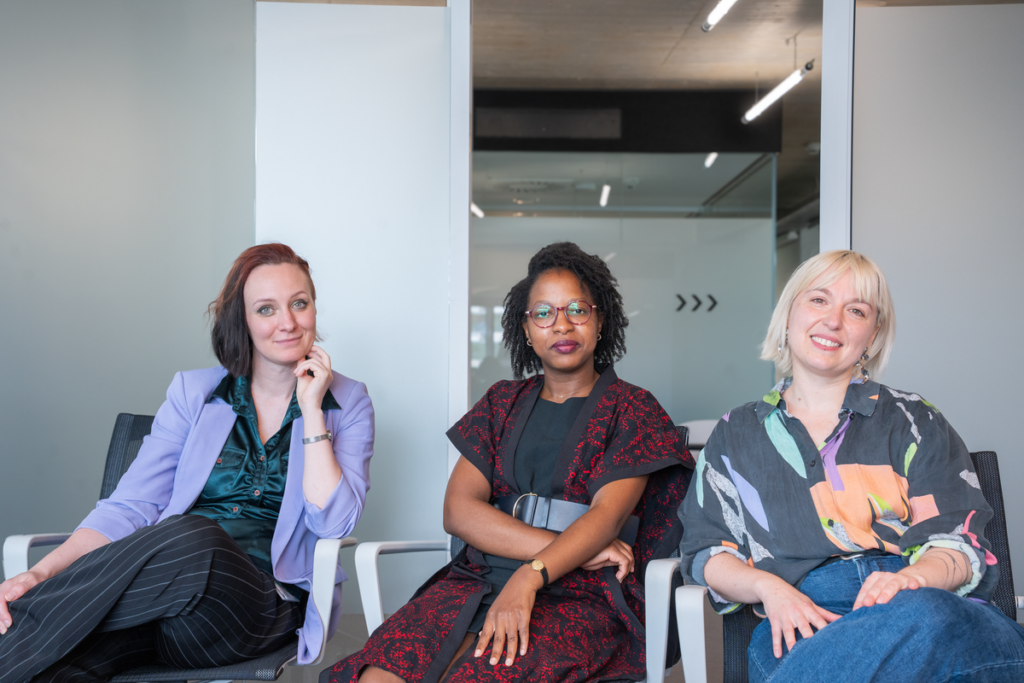
Creating a new university comes with obvious logistical challenges. Yet for Sonja Rattay, Chair of IT:U’s First Committee for Equality and Women’s Advancement, Stefanie Lietze, Teamlead for Equal Opportunities and Quality Assurance, and Anne Odongo, Gender & Equal Opportunities Support, it also presents a unique opportunity.
IT:U has had the rare opportunity to design its structures from scratch. Rather than treating diversity as an initiative that exists alongside teaching, administration, communication and research, the organization is aiming to embed inclusion into the foundations of the institution itself by making it a cross-sectional responsibility of all the universities members, supported by a collegial body as well an office.
The result is a university where equality is not an afterthought, but part of how quality, excellence, and innovation are defined.
Technology reflects the people who build it
No technology is entirely neutral. Every dataset selected, every research question asked, and every design decision reflects human perspectives. When those perspectives are too similar, blind spots become inevitable, and biases get built in, diminishing the quality of the product.
History offers numerous examples. Early voice recognition systems struggled to understand higher-pitched voices because they were primarily trained on male speech patterns. Early face recognition software mislabeled black faces drastically. Medical AI has performed less accurately for women because much of the underlying research relied predominantly on male datasets. The same bias applies to non kaukasian people. Poorly designed websites, apps, and digital services can also make them difficult or even impossible to use for people with disabilities. Even everyday products, such as smartphones and safety equipment, have often been designed with the average male user in mind.
These examples rarely result from malicious intent. They emerge when too few perspectives are present during development. Increasing diversity therefore isn’t about political correctness. It’s about creating products accessible to everyone before they reach society.
“The greatest barrier to better technology isn’t a lack of talent, it’s a lack of perspectives.”
Stefanie Lietze, Teamlead for Equal Opportunities and Quality Assurance
Excellence grows through diversity
One argument against diversity initiatives suggests that organizations should simply hire “the best person for the job.” IT:U agrees. The challenge lies in recognizing that highly qualified candidates often face structural barriers that have little to do with their abilities.
Biased recruitment processes, unfair excellence criteria, inaccessible systems, unequal networking opportunities, or expectations around relocation and caregiving responsibilities can all influence who ultimately enters academia and technology.
Removing these barriers does not lower standards. It expands the talent pool from which excellence can emerge. This is particularly important in computing, where innovation depends on combining different ways of thinking, but also on bringing together knowledge from different disciplines.
Interdisciplinary collaboration can help identify problems, perspectives, and solutions that may be overlooked within a single field. By combining technical expertise with insights from fields such as social sciences, design, medicine, or the humanities, we can develop technology that is more innovative, inclusive, and responsive to the needs of society.
Diverse teams are more likely to challenge assumptions, identify overlooked problems, and develop solutions that work for a broader range of people. Research on team performance shows that cognitively diverse teams produce more creative solutions and make better decisions when tackling complex problems.
“Diversity and excellence are not competing goals. By removing structural barriers, universities gain access to the best talents, and better outcomes.”
Sonja Rattay, Chair of IT:U’s First Committee for Equality and Women’s Advancement
Redefining what excellence looks like
Academic institutions have traditionally rewarded a narrow set of achievements, focusing heavily on publications and research output. Yet universities depend on a much broader range of contributions to thrive. Excellent supervision, mentoring, science communication, interdisciplinary collaboration, and academic service all strengthen research environments and student experiences.
However, these contributions are often undervalued in traditional career progression. Expanding the definition of excellence means recognizing the full spectrum of work that advances science, society and economy. For this reason, IT:U measures academic excellence using a matrix of criteria oriented on the DORA-Framework and based on the CoARA-principles.
Measuring inclusion instead of assuming it
Recognizing different forms of excellence also requires understanding who has access to opportunities. Good intentions alone do not reveal whether structures are working as intended.
A department may recruit more women, for example, while still sending predominantly male researchers to conferences or assigning leadership opportunities unevenly. To identify these patterns, IT:U is developing a comprehensive monitoring and reporting system that evaluates how opportunities are distributed across the university.
Rather than relying on perception, the system provides measurable data every semester and helps translate findings into concrete actions, creating transparency and enabling continuous improvement.
Inclusive foundations for technological excellence
The conversation about women and minorities in technology often begins with representation. It should end with (e)quality. When different perspectives are present throughout research, teaching, planning, development, and implementation, technologies become more reliable, more accessible, and more relevant to the societies they serve.
This is why IT:U views diversity not as an objective separate from excellence, but as one of its foundations. As universities prepare the next generation of researchers and innovators, the question is no longer whether diverse voices belong in technology.
The question is whether technology can afford to develop without them.