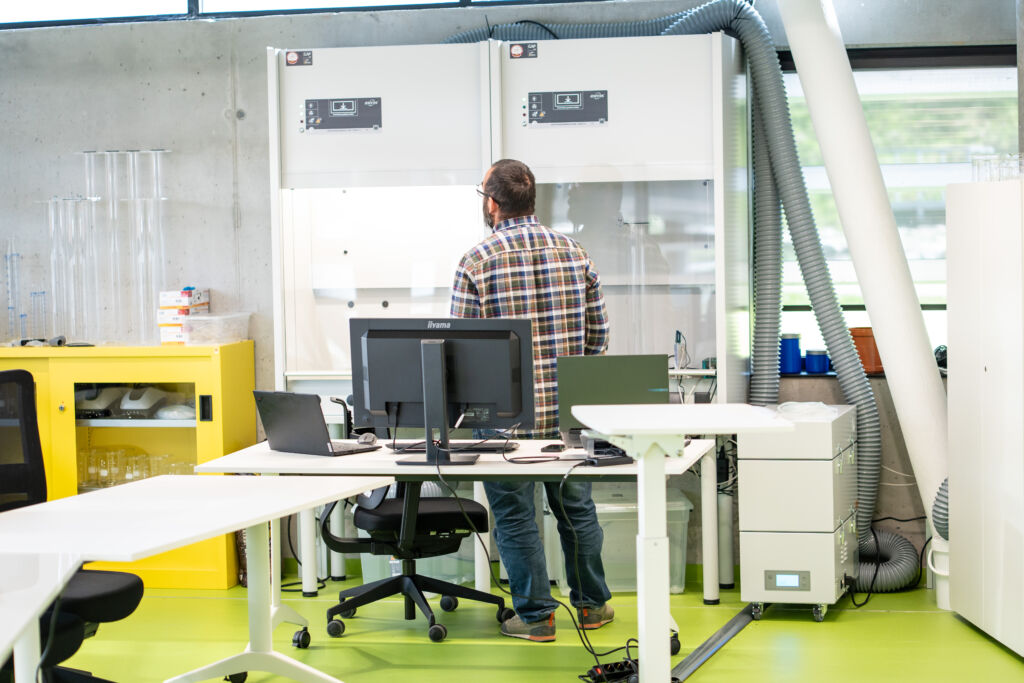


First Wet Lab for AI‑enabled environmental and circular economy research
With the commissioning of its first wet lab for environmental research, IT:U is extending its research and teaching model into the physical realm. For the first time, digital technologies, artificial intelligence (AI) and ecological systems are brought together in a shared experimental setting.
Digital technologies and real‑world experiments merge to prototype tomorrow’s circular solutions
Beyond data‑driven systems, the new wet lab ERIN puts material and environmental questions center stage. Core themes include circular economy, resource efficiency, and how AI‑based approaches can help transform industrial processes.
“Today’s major challenges emerge at the interface of digital and physical systems. Anyone serious about addressing climate change or sustainable production must design both together.”
Wolfgang Kienreich, Technology Strategist at IT:U and responsible for building the labs.
From models to materials: innovations for sustainable industrial transformation
The environmental wet lab is live and embedded in IT:U’s LearnLab architecture. Students, researchers, and external partners collaborate on real‑world challenges from industry and society. The goal is not only to generate knowledge, but to translate it into solutions and test them under real conditions.
This creates a clear entry point for collaboration: partners can bring their challenges into an interdisciplinary setting, with immediate access to research, talent, and rapid prototyping.
Use cases based on this project-based learning approach include:
- Build and improve a small gas biofilter by adjusting the filter material, airflow time, moisture, and nutrients to boost pollutant removal.
- Measure air pollutants with calibrated sensors and follow clear routines to check data quality.
- Collect, clean, and plot performance data with basic coding to see what works and decide next steps.
- Create models that link how gases move and are broken down in the filter to predict performance and plan scaleup.
- Connect biofilters with an aquaponics setup to reuse nutrients and design lowimpact, circular systems.
- Practice startup, control, and maintenance (e.g., safe commissioning, handling sudden pollutant spikes, preventing clogging) under real lab conditions.
- Compare different filter designs and materials for common pollutants (e.g., VOCs, hydrogen sulfide, ammonia) and weigh cost, energy use, and resource impacts.
With this approach, IT:U is deliberately positioning itself as an interface between science, industry, and society. The combination of AI methods and experimental environments creates a new level of practice-oriented research and education, with a clear link to industrial and ecological transformation.
Interested in the position paper or in collaborating?
Contact IT:U’s Outreach & Startups team now