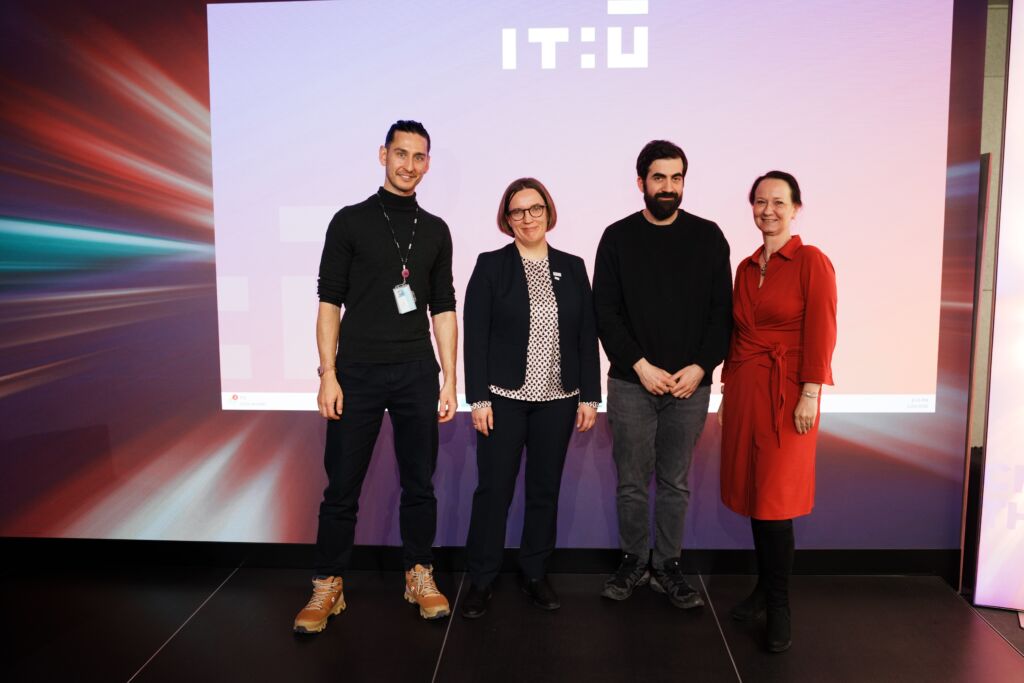


Inaugural Lecture – Advancing Health Through Data
Across healthcare and the life sciences, data is transforming how we understand disease and deliver care. As healthcare systems grapple with aging populations, multiple diseases, and the rise of next-generation therapies, progress increasingly depends on bringing disciplines together. In their First Lecture, IT:U Founding Professors Spiros Denaxas and Kristin Reiche show how clinical insights, data science, computer science, molecular biology, and bioinformatics can – and must – interlock to turn complex data into better decisions for patients.
Improving human health and healthcare through data science – Spiros Denaxas
Spiros Denaxas , Professor of Computational Medicine , brings a clinician’s questions together with a data scientist’s toolkit: how do diseases evolve throughout a lifetime, and how can we tailor care for each patient? His research brings valuable insight into:
- People are living longer, but often with multiple mental and physical health conditions: By understanding which diseases occur together, in whom, and at what stage of life, it’s possible to provide doctors with the insights needed for better treatment choices and help policymakers plan more effective healthcare services for the future.
- Diseases often get treated as if they are the same in everyone, but in reality, they rarely are: This is why certain medications work for some people but not for others. One of Spiros’ projects uses machine learning to analyze complex health records, which allows them to identify meaningful “subtypes” of diseases. Understanding these differences, can pave the way for new medications and ensure that every patient receives the treatment that is most accurate for their specific condition.
“Health data science bridges the gap between clinical medicine, data science, and computer science to decode the complexities of human health. By transforming vast, fragmented biomedical data into actionable insights, it empowers us to predict disease trajectories and personalize care for every individual.”
Spiros Denaxas, Professor of Computational Medicine
Is digitalization in Molecular Medicine a moonshot project? – Kristin Reiche
Kristin Reiche, Professor of Digital Molecular Medicine, focuses on translating molecular data into actionable insights for clinical decision-making. Molecular Medicine uses data derived from advanced diagnostic tools to understand and diagnose disease. While in research these data types are widely used, there are substantial barriers for implementing molecular medicine in health applications. Reiche outlines how her research group at IT:U aims to help overcome these barriers:
- New types of therapies like adoptive cellular immunotherapies stimulate the patient’s immune system to fight cancer: As they actively modulate immune cell biology, a thorough understanding of their complex mechanisms of action is essential. Reiche and her team evaluate treatment responses to adoptive cellular immunotherapies by bridging computer science and molecular biological assessment of (single) cells. This helps clinicians see sooner whether a treatment is working and tailor care.
- From single-cell insights to treatment choices: Integrating molecular and cell biological data into adoptive cellular immunotherapy development and treatment decisions requires validated, interoperable bioinformatics pipelines. Therefore the Digital Molecular Medicine Research Group develops data processing frameworks tailored to the needs of this novel class of therapies. These reliable data tools turn complex lab results into clear guidance so patients receive the right treatment at the right time.
“Yes, digitalization in Molecular Medicine is a moonshot project, but an achievable one: To overcome the barriers of digitalization in Molecular Medicine, transformation in medical bioinformatics is needed. We will only achieve this through interdisciplinary collaboration” .
Kristin Reiche, Professor of Digital Molecular Medicine
From Big Data to Single Cells: A Roadmap to Personalized Care
This First Lecture shows that better health outcomes happen when disciplines connect:
- Spiros Denaxas looks at the bigger population level: using machine learning on large-scale health data to understand when diseases occur, in whom, and why treatments help some people but not others.
- Kristin Reiche adds the molecular view: her team uses advanced tools like single‑cell and genomic assays to uncover how diseases work at the cellular level and to support next‑generation therapies.
Together, their approaches form a clear roadmap – from disease subtyping and prediction to interoperable data pipelines – that turns complex information into practical decisions for clinicians, leading to more precise, timely, and personalized care.
About the First Lectures
The “F1rst Lectures” format offers exciting insights into the eleven research groups at IT:U, Austria’s new technical university focusing on digital transformation. Grounded in interdisciplinary research and project-based, personalized learning, IT:U is dedicated to advancing digital transformation, actively shaping it and driving it forward through solution-oriented approaches.