
 Falko Ueckerdt
Global industry transformation: redirecting investments toward climate-neutral processes
The transformation of industry—especially basic materials such as steel, cement, chemicals, and aluminium—is a crucial bottleneck on the path to climate neutrality. Over recent decades, efficiency gains have not kept pace with rising demands: the GHG intensities of major basic materials have nearly stagnated, while demand has continued to grow. As a result, industry emissions have increased faster since 2000 than emissions in any other sector, and when indirect emissions from electricity and heat are included, industry accounts for around one-third of global GHG emissions.
Reaching climate-neutral basic materials therefore requires going beyond incremental improvements such as energy efficiency. It calls for demand-side strategies (material efficiency, longer product lifetimes, reuse, recycling, circular economy) alongside supply-side transformation toward fundamentally new production processes—and the rapid build-out of enabling systems such as low-carbon electricity and hydrogen, as well as CO₂ transport and storage and expanded electricity and hydrogen infrastructure. The urgency is heightened by the sector’s investment inertia: industrial facilities are capital-intensive and long-lived, creating a significant risk of fossil-carbon lock-in unless near-term investments shift decisively toward low-emission options.
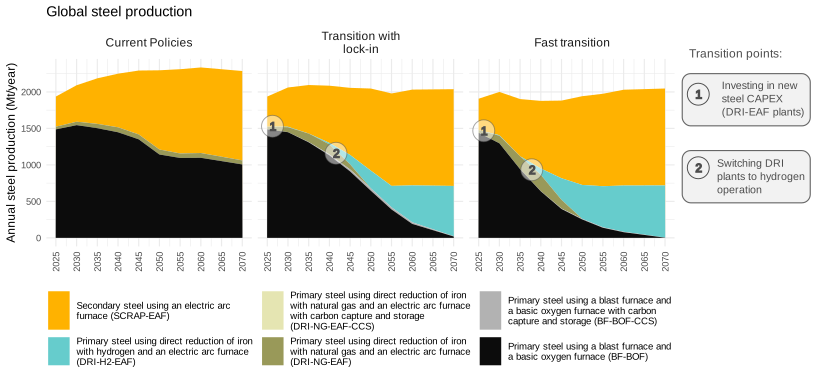
Global steel production by route and transition levers (2025–2070). Stacked areas show annual global steel output (Mt/yr) across major production routes under three scenarios: Current Policies (no additional climate policy), Transition with lock-in (based on coal-based steel plants planned today), and Fast transition (averting the lock-in through early investments into direct-reduction shaft furnaces: DRI–EAF). Based on a paper in review: Bachorz et al. (2026) Averting the steel carbon lock-in through strategic green investments (preprint), DOI: 10.21203/rs.3.rs-8435240/v1.
A concrete example is our recent work on the global steel sector (currently under review). Combining plant-level asset data with scenario analysis, we quantify how today’s capacity and project pipeline translate into committed future emissions. We show that existing and planned coal-based steel plants could commit the world to nearly 60 Gt CO₂ through 2070—and that lock-in could rise to ~115 Gt CO₂ if current investment trends continue beyond currently announced plans. Importantly, we find that around 60% of this lock-in can be avoided at moderate average abatement costs (~US$100–150 per tCO₂) through timely, strategic green investments into hydrogen-based primary steel making. In India alone, ~22 Gt CO₂ of future emissions could be avoided by redirecting ~US$50 billion this decade toward hydrogen-ready DRI–EAF capacity—illustrating how targeted policy and climate finance can unlock early investment decisions and accelerate diffusion.
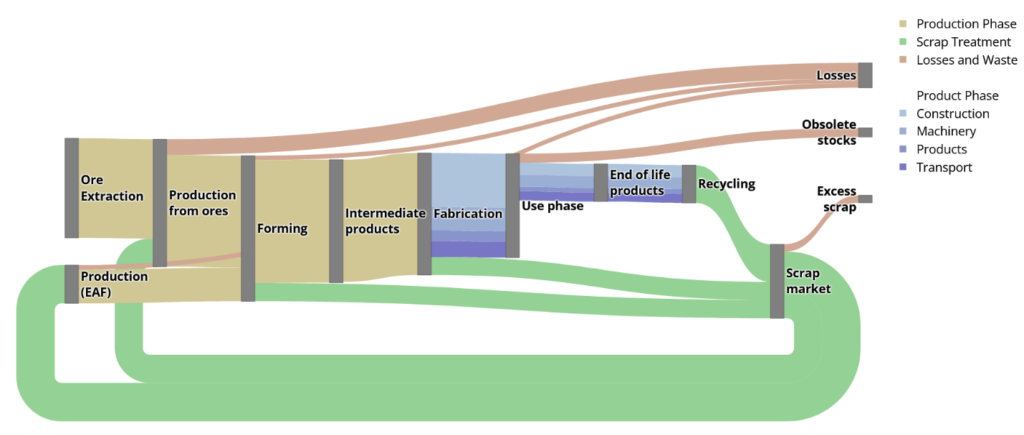
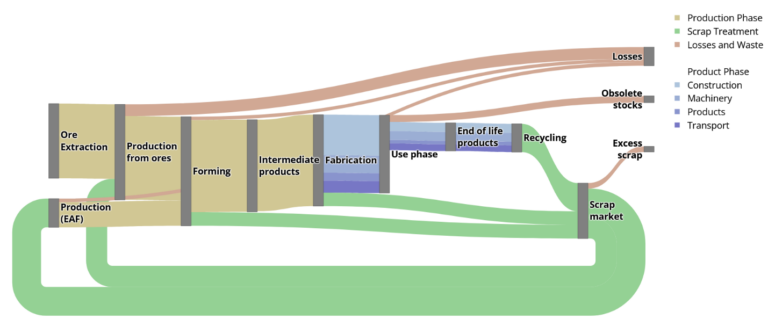
Global material flows for steel in 2022 (iron flows only), resolved into production, use, recycling/scrap treatment, and losses & waste.
Another key low-emission steelmaking option is to increase scrap-based secondary steel instead of primary steel (orange area in the figure above). However, this circular route is constrained by scrap quality (impurities in recycled steel) and scrap availability. To quantify these constraints and the underlying dynamics of scrap availability and trade, we use a dynamic material-flow analysis (MFA) for steel (based on the REMIND-MFA framework), implemented with flodym—a new open-source library we are developing as a next step beyond the established ODYM framework. The MFA resolves steel’s full life cycle from iron ore extraction and primary production to manufacturing, use, end-of-life, recycling, and the scrap market.