
 Falko Ueckerdt
Hydrogen project evaluation
Since 2013, we have closely observed the development of hydrogen projects and advised governments and industry on the future role of hydrogen in the energy transition.
Most recently, we published the Nature Energy paper “The green hydrogen ambition and implementation gap”, which has attracted substantial attention. In this work, we compile and track all existing and planned green hydrogen projects worldwide to quantify two newly introduced concepts: the green hydrogen ambition gap and the implementation gap. Our results show that green hydrogen deployment is currently off track—and we outline what would need to change to close these gaps.
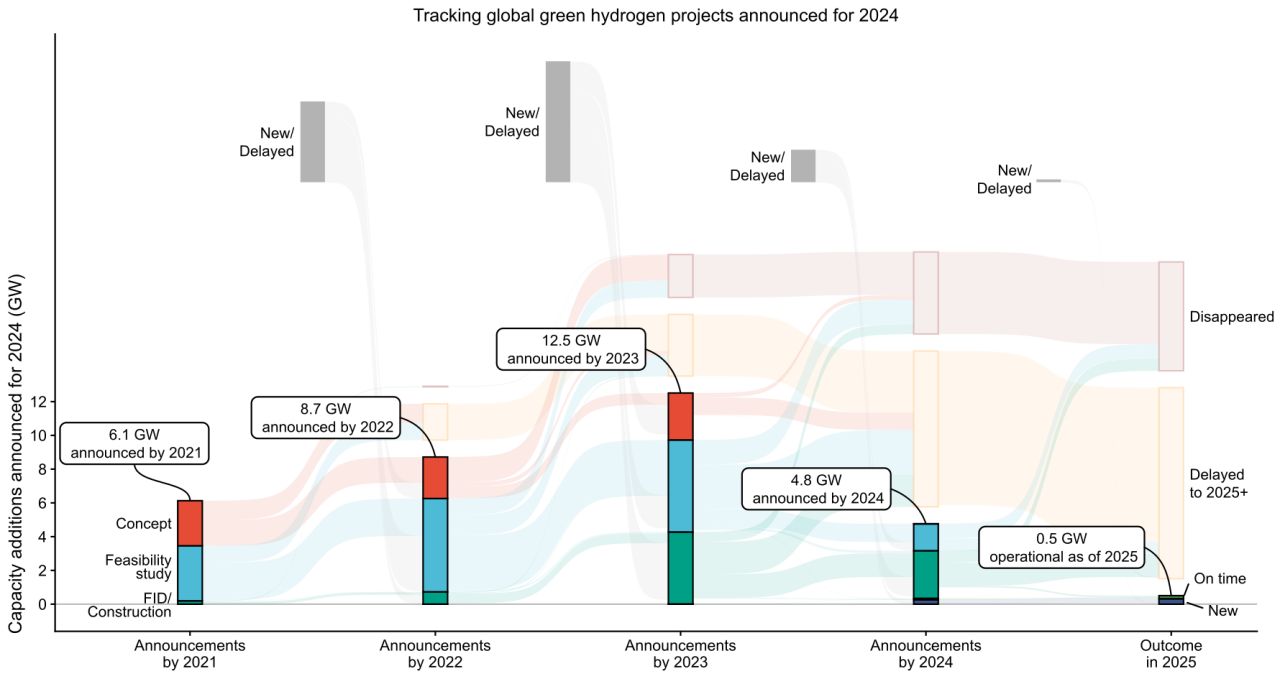
Source: Odenweller, A. & Ueckerdt, F. The green hydrogen ambition and implementation gap. Nat Energy 10, 110–123 (2025). https://www.nature.com/articles/s41560-024-01684-7
More specifically, the latest IEA data (2025) indicate that only 4% of announced electrolysis capacity was delivered on time: 0.5 GW realised versus 12.5 GW announced just one year earlier (see figure). The dataset reveals a clear wave-like pattern: announced capacity grows while the commissioning year is still distant, but drops sharply as that year approaches. Many projects are delayed, and a significant share disappears entirely.
At the same time, despite these setbacks, electrolysis capacity is growing rapidly—by more than 50% per year over the past five years. Yet this pace still falls far short of what earlier project announcements implied. The key challenge for policymakers and industry is to reset expectations toward high-value, credible hydrogen use cases (e.g., in primary steel making) and to de-risk projects—for example through dedicated policy support, demand-side quotas, robust infrastructure planning, and bankable offtake arrangements—so that more projects reach final investment decisions.