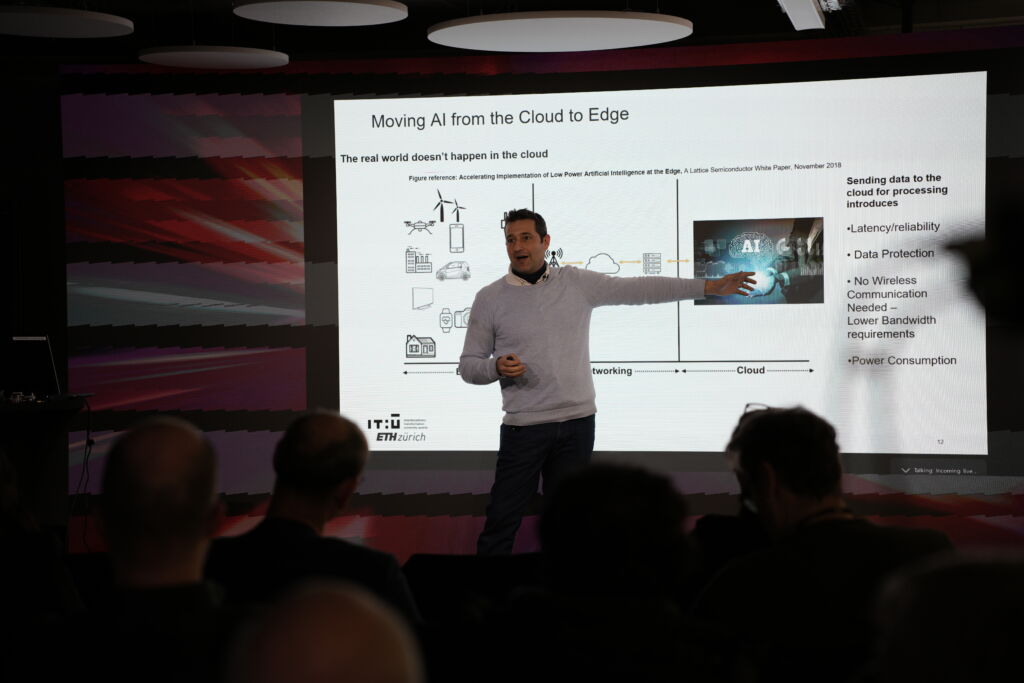


Network Spotlight – From Sensors to Intelligence: Building the Future of Edge and Physical AI
The latest Network Spotlight at IT:U – Interdisciplinary Transformation University Austria focused on how intelligence is moving from centralized cloud systems into the physical world. Fellow Professor Michele Magno presented his keynote, From Sensors to Intelligence, highlighting how Edge and Physical AI enable systems to sense, process, and act directly where data is generated.
From Sensors to Intelligence
In his keynote, Prof. Magno introduced the emerging field of Edge and Physical AI, which brings intelligence directly to devices operating in the real world. Rather than relying on centralized cloud computing, these systems process data locally, reducing energy consumption, latency, and dependency on constant connectivity.
His research at the Smart Sensing Systems Laboratory (S³Lab) bridges hardware design, efficient AI, and communication technologies to create systems that are energy-aware, context-adaptive, and designed around human needs. This interdisciplinary approach enables intelligent behavior at the edge, where sensing, decision-making, and action happen in real time.
Where Research Meets Education
A central theme of the talk was the close integration of research and education. Prof. Magno highlighted how project-based learning (PBL) is embedded directly into research activities at IT:U. Students do not only study concepts but actively design, build, and test real systems, from low-level sensors to fully functional intelligent prototypes. This hands-on approach accelerates innovation while preparing students to think across disciplines, combining engineering, AI, and system-level thinking to address real-world challenges.
“Technology education must evolve with technology itself. Through Physical AI and project-based learning, we merge research and teaching, enabling students to design, build, and understand intelligent systems that interact with the real world. This fusion of edge intelligence and experiential learning prepares a new generation of innovators ready to tackle societal challenges with creativity, responsibility, and purpose.”
Michele Magno, IT:U Fellow Professor of Embedded Systems & Edge AI
From Theory to Real-Life Applications
Prof. Magno presented several concrete project examples that demonstrate how Edge and Physical AI translates into impact:
- Smart Glasses with Edge AI: Open, low-power smart glasses that perform on-device eye tracking and health monitoring, showcasing embedded intelligence for everyday use.
- Wearable Radar for Vital Signs: Compact radar systems enabling continuous, non-contact monitoring of breathing and heart rate, addressing healthcare and humanitarian applications.
- Autonomous Edge Robots: Drones and robotic dogs equipped with embedded AI for precision agriculture and search-and-rescue missions in remote or hard-to-reach environments.
- Intelligent CubeSat Project: A student-led initiative combining smart sensing, edge AI, and satellite-to-Earth communication for autonomous Earth observation.
Together, these projects illustrate how Edge and Physical AI can make technology more efficient, adaptive, and inclusive, while offering students authentic learning experiences that merge research and education.
About the Network Spotlight
The Network Spotlight at IT:U is designed to open up the work of our Fellows to a wider audience, highlighting innovative research that thrives on interdisciplinarity. It also underlines IT:U’s role as a Network University—linking researchers, innovators, and thought leaders to exchange perspectives and spark new collaborations.
Save the date: 7th Network Spotlight
“More Than Cognition: Socio-Emotional Processes in Learning with Human and AI Tutors“
📅 January 27, 2026
⏰ 17:00 – 18:30
📍 Interdisciplinary Transformation University, Altenberger Straße 66c, 1st floor, 4040 Linz, Austria
Speaker: IT:U Fellow Prof. Manuela Paechter